This Headline Grabs Visitors’ Attention

A short description introducing your business and the services to visitors.

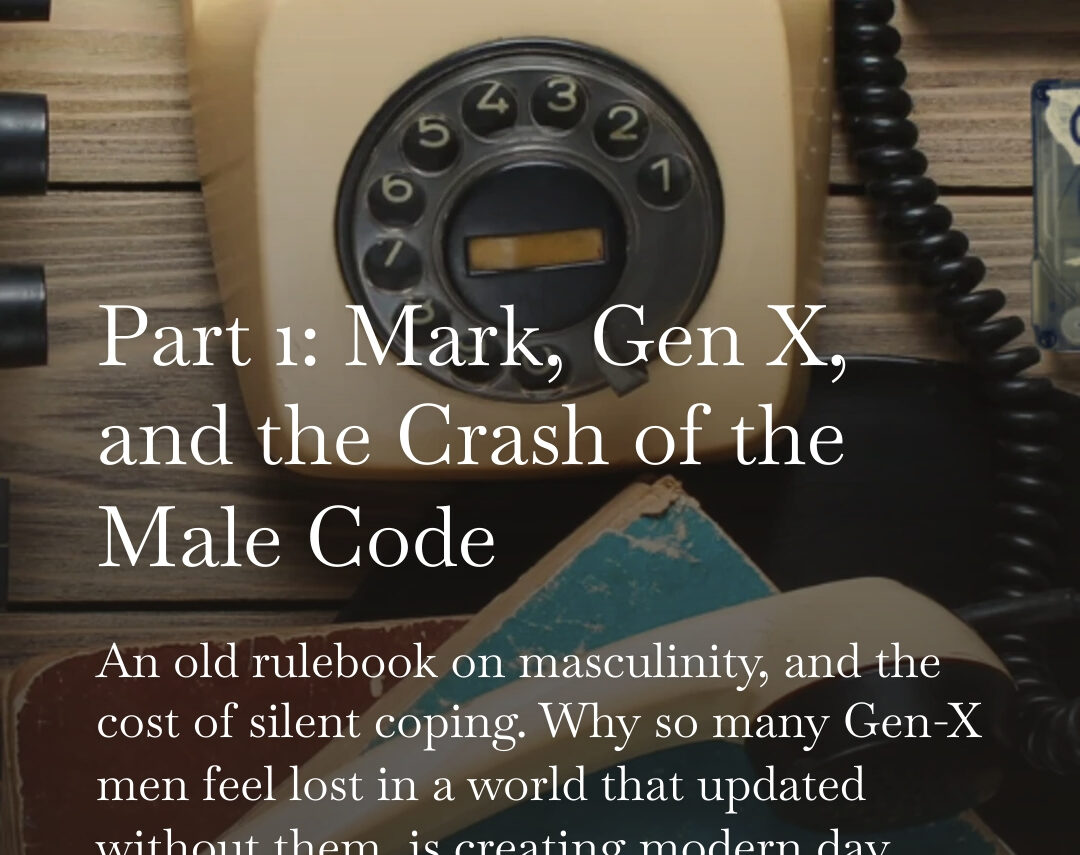
Part 1: Mark, GenX, and the Crash of the Male Code

GenX relationship problems
Share the Post:

Related Posts

GenX relationship problems

Part 2: Mark, GenX, and Why the 1980s Playbook Isn’t Cutting It Anymore

Meet Mark. Born in 1972. Age 53. Raised on U2, cheap beer, and the smell of sea salt from the ocean breeze. His parents? Half a world away emotionally. His grandparents? Together, performing their daily rituals with stoic survival instincts passed down like a cursed family heirloom. Childhood wasn’t about hugs. It was about not pushing the buttons on the spoken or unspoken rules, and figuring out that feelings were either weapons or liabilities.

Read More
GenX relationship problems

Part 1: Mark, GenX, and the Crash of the Male Code

Meet Mark. Born in 1972. Age 53. Raised on U2, cheap beer, and the smell of sea salt from the ocean breeze. His parents? Half a world away emotionally. His grandparents? Together, performing their daily rituals with stoic survival instincts passed down like a cursed family heirloom. Childhood wasn’t about hugs. It was about not pushing the buttons on the spoken or unspoken rules, and figuring out that feelings were either weapons or liabilities.

This Headline Grabs Visitors’ Attention

A short description introducing your business and the services to visitors.

Part 1: Mark, GenX, and the Crash of the Male Code

GenX relationship problems
Share the Post:

Related Posts

GenX relationship problems

Part 2: Mark, GenX, and Why the 1980s Playbook Isn’t Cutting It Anymore

Meet Mark. Born in 1972. Age 53. Raised on U2, cheap beer, and the smell of sea salt from the ocean breeze. His parents? Half a world away emotionally. His grandparents? Together, performing their daily rituals with stoic survival instincts passed down like a cursed family heirloom. Childhood wasn’t about hugs. It was about not pushing the buttons on the spoken or unspoken rules, and figuring out that feelings were either weapons or liabilities.

Read More

Join Our Newsletter

GenX relationship problems

Part 1: Mark, GenX, and the Crash of the Male Code

Meet Mark. Born in 1972. Age 53. Raised on U2, cheap beer, and the smell of sea salt from the ocean breeze. His parents? Half a world away emotionally. His grandparents? Together, performing their daily rituals with stoic survival instincts passed down like a cursed family heirloom. Childhood wasn’t about hugs. It was about not pushing the buttons on the spoken or unspoken rules, and figuring out that feelings were either weapons or liabilities.
Share the Post:

Related Posts

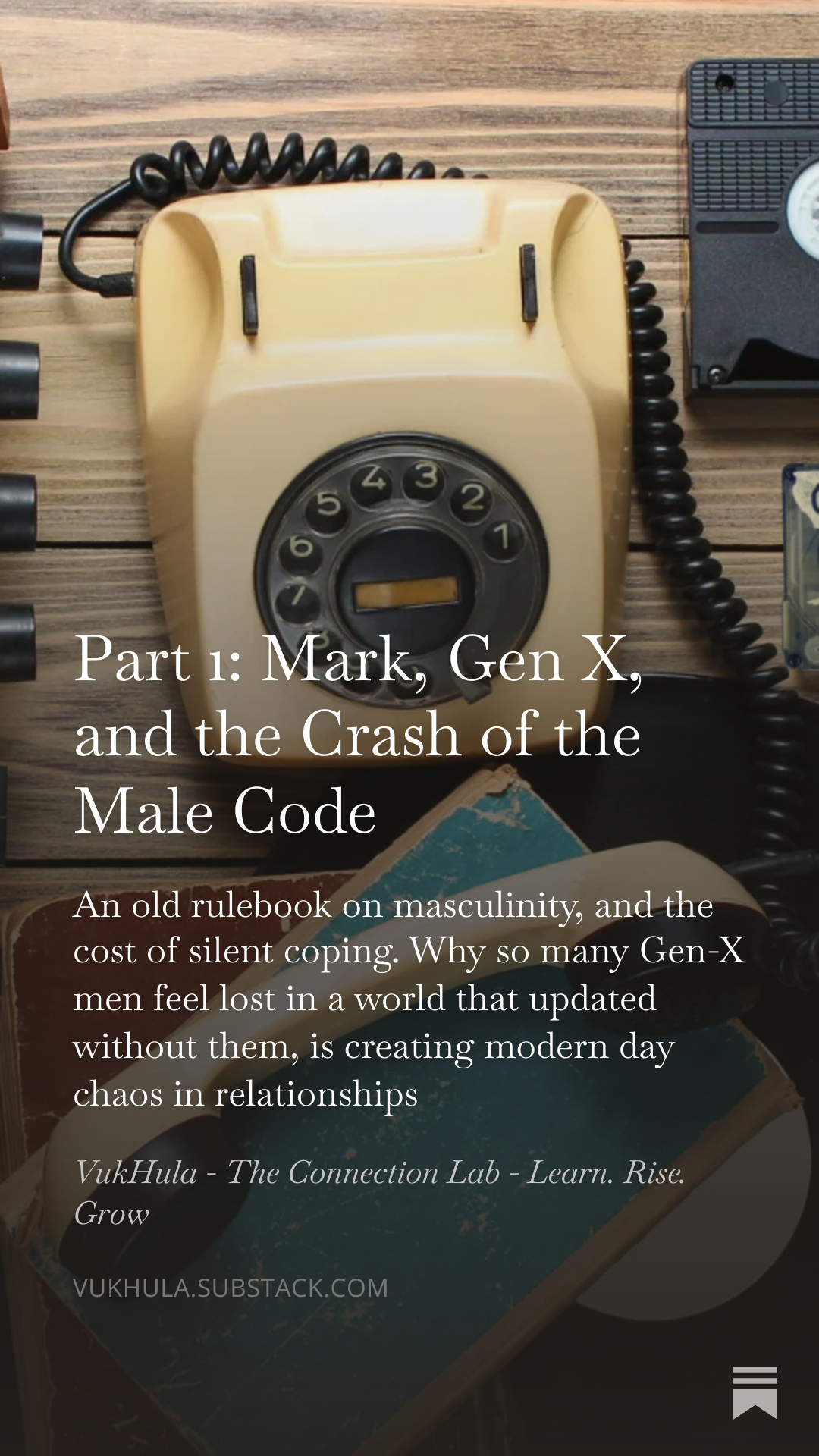
Part 1: Mark, Gen X, and the Crash of the Male Code

An old rulebook on masculinity, and the cost of silent coping. Why so many Gen-X men feel lost in a world that has updated without them is creating modern-day chaos in relationships.

GenX relationship problems

Meet Mark. Born in 1972. Age 53. Raised on U2, cheap beer, and the smell of sea salt from the ocean breeze. His parents? Half a world away emotionally. His grandparents? Together, performing their daily rituals with stoic survival instincts passed down like a cursed family heirloom. Childhood wasn’t about hugs. It was about not pushing the buttons on the spoken or unspoken rules, and figuring out that feelings were either weapons or liabilities.

Mark grew up thinking toughness was the only currency that mattered. Crying? Weak. Talking about feelings? Soft. Anger? Manageable, preferably in private with a baseball bat or a pool cue. Love? Show it by fixing shit, mowing the lawn, and bringing home bacon, literally and metaphorically.

Back then, cigarettes and booze were the social status and a glue for stress relief, and the Saturday-night performance enhancer. Life lessons were delivered between a beer, a VHS tape, and a laugh at someone else’s misfortune. Sex education was either a stolen video from your mate’s stepdad or overheard from a cousin, passed down like an urban legend. Therapy? Hah. Journals? “Dear Diary?” That was for girls and sad losers. Real men drank, fought, worked, and endured.

Fast forward to today. Mark is trying to survive in a world that no longer gives stoicism a gold star, where vulnerability is apparently in the top five relationship must-haves, right under “owning your emotional baggage” and “not ghosting your partner.” Emotional intelligence is now a KPI, and Instagram couple goals make him feel like a museum exhibit. His kids want “feelings talks,” and his wife is drowning in algorithms pushing unsolicited marriage advice while expecting him actually to show up. And Mark? He’s spinning like a hamster on espresso, flailing toward his old coping tools, booze, sarcasm, and escapism, the same ones that got him through high school, the eighties, and roughly half his marriage.


The Disconnect Is Brutal

See, Mark’s brain is hardwired for survival, not connection. His amygdala screams at the slightest threat. His prefrontal cortex, designed for delayed gratification and problem-solving, wasn’t trained to decode emotional nuance or navigate neurotic modern relationships. Back then, ignoring feelings kept you alive. Today, it’s driving him into stress, insomnia, gut issues, and that quiet rage that bubbles under every interaction.

And here’s the cruel irony: Mark isn’t failing at life. He’s failing at the new rules of living. The ones where showing vulnerability is strength, asking for help is necessary, and silence can kill connection faster than any fight-or-flight response. His old code of “work hard, shut up, keep drinking, never complain” may have worked for raising a family in the 80s, but now leaves him a bit behind the times, lost and buffering in a world that’s upgraded without him.

A Collision Of Eras

Mark’s world is a collision of eras. Like a world-class athlete training at altitude but competing at sea level; nothing syncs, nothing fires right. Mindfulness apps, and twenty-somethings who can name fifty shades of emotional nuance while he’s still trying to remember his wife’s birthday. His dad was born during WWII, his grandfather… survived WWII, his dad’s dad survived something worse, and now Mark? He’s surviving an emotional blitzkrieg delivered in DMs, Zoom calls, and high school soccer practices.

And yet Mark keeps his humour. Sarcasm is his defensive shield. He drinks like it is still 1989, although his performance is glitchy. He scrolls through memes about male inadequacy, wondering quietly if they are aimed at him. He is not broken. He is a relic running on outdated code, trying desperately to patch a system that never came with instructions.


Fallout: Mark vs. Modern Life

Mark’s life is not broken. It is misaligned, like a Walkman trying to play a Spotify playlist. He is 53 and running the script he was handed. Silence means strength. Suffering builds character. Booze solves a surprising number of problems.

Meanwhile, the world has rewritten the manual. It is brutal. The operating system was upgraded overnight while he was still trying to understand why the office suddenly had gender neutral toilets and kombucha on tap. Now he is labelled toxic for behaviours once considered normal, not because he is a bad man, but because his rulebook was carved into him with the principal’s cane or his father’s belt. The rules belonged to another era.

So Mark is not toxic. He is outdated. So Mark is not failing. He is misaligned. He is lagging in the update. And lagging reads like resistance, even when it is nothing more than confusion wrapped in bravado.


Current Day Defensive Stats

Enter Sarah, his wife. Still sharp, still exhausted, still clinging to the memory of the man who fixed things, protected things, and danced like an idiot in their twenties. Today, she is married to a man whose emotional vocabulary consists of “fine, let’s fix it” and “want a sandwich?” She wants presence. He tries to deliver practical solutions (without AI), invoices, and schematics. Not because he is cold. Because he is wired like a soldier from the seventies. Mission-focused. Solution-driven. Emotionally armoured. Armour is heavy when you have been wearing it since childhood.

Parenting is another battlefield. His kids do not need protection in the way he imagines. They need emotional attunement, boundaries that feel like safety, and encouragement for surviving the social minefield of modern school life. Mark’s internal map still says watch sport, provide, survive. When the kids ask questions about sexual orientation at age nine, he freezes. A familiar withdrawal creeps in, scented with distraction and booze.


Enter the modern dopamine battlefield.

In the eighties, pleasure came from a cold beer, a burger, a rock concert, and a reckless weekend decision. Today, it arrives through social media, gaming platforms, notifications, online porn, and endless streaming. Each one is a micro hit designed to rewire the brain. Mark’s prefrontal cortex, which once planned road trips, now gets hijacked by pixels and algorithms. Every night, he battles between scrolling through an eighteen-year-old babysitter fantasy or stalking someone else’s curated life, all while drowning in an emptiness that whisky cannot numb forever.


The Unpredictable Career Ladder

Mark once understood the rules of work. Hierarchies were clear, ladders were predictable, and loyalty meant something. Now, competence and grit are overshadowed by branding, networking, and whatever management calls culture. He watches colleagues rise through charm rather than skill while he clings to values that no longer protect him. HR fires him via email. Not because he is incompetent, but because the system changed without warning. Like a vinyl record skipped by a cloud update.

His friends are in similar chaos. Divorced, medicated, starting companies, or deep in midlife spirals. Some chase the fantasy of a thirty-year-old who supposedly likes older men with sports cars and unresolved childhood trauma. The old rituals are relics. The fights, the beers, the road trips. Nostalgia, not solutions.

Humour remains one of his last weapons. Sarcasm is still his shield. Without it he would lie awake wondering whether he is failing at life or simply failing at the new one thrust upon him.


Navigating Digital Age Dopamine Traps

Mark knows there is more to him. He knows he could be a father who responds with intention rather than instinct. A husband who shows up instead of shutting down. A man running his own mind instead of outsourcing it to bad habits. But every step toward emotional sovereignty feels like stepping into a minefield because the map he inherited from the seventies never included instructions for intimacy, vulnerability, or dopamine regulation.

So he drinks. He jokes. He keeps moving. He has survived wars of his own making, and now he faces one he never trained for. A war against outdated wiring and an indifferent world.


The Veteran Of Life’s Strangest Battles

Mark is not broken. He is a battle-hardened survivor of emotional silences, recessions, Cold War fear, questionable hairstyles, and a childhood built on emotional blackout drills disguised as tough love. Yet the world has changed. His operating system is no longer compatible.
Further Reading for the Curious

If you’re interested in why Mark isn’t failing, just lagging, and why the old “stoic male code” has consequences in modern life, here are some accessible, open‑access studies and reviews. “Mark phenomenon” isn’t just anecdotal; it’s real, measurable, and backed by research.

  • Emotional suppression and mental health — Meta-analysis of over 21,000 participants shows that suppressing emotions links to higher anxiety, depression, and lower life satisfaction. Read more
  • Traditional masculinity norms and men’s mental health — Research shows rigid adherence to old-school masculine norms correlates with internalising problems and lower emotional awareness. Read more
  • Emotional intelligence and relationship satisfaction — Men and women with higher emotional intelligence experience greater intimacy, empathy, and satisfaction in relationships. Read more
  • Coping strategies and well-being — Using avoidance and suppression for stress management is linked to worse long-term outcomes; emotional-approach coping improves resilience and mental health. Read more
  • Masculinity, social connection, and loneliness — Sticking rigidly to traditional masculine codes contributes to isolation and poorer social relationships. Read more
  • Psychophysiological effects of emotional suppression — Bottled-up feelings manifest physically, impacting health, stress response, and relationships. Read more
  • Emotional suppression in marriage — Suppressing emotions harms marital satisfaction and increases stress for both partners. Read more
Share the Post:

Related Posts

Part 1: Mark, Gen X, and the Crash of the Male Code

An old rulebook on masculinity, and the cost of silent coping. Why so many Gen-X men feel lost in a world that has updated without them is creating modern-day chaos in relationships.

GenX relationship problems

Meet Mark. Born in 1972. Age 53. Raised on U2, cheap beer, and the smell of sea salt from the ocean breeze. His parents? Half a world away emotionally. His grandparents? Together, performing their daily rituals with stoic survival instincts passed down like a cursed family heirloom. Childhood wasn’t about hugs. It was about not pushing the buttons on the spoken or unspoken rules, and figuring out that feelings were either weapons or liabilities.

Mark grew up thinking toughness was the only currency that mattered. Crying? Weak. Talking about feelings? Soft. Anger? Manageable, preferably in private with a baseball bat or a pool cue. Love? Show it by fixing shit, mowing the lawn, and bringing home bacon, literally and metaphorically.

Back then, cigarettes and booze were the social status and a glue for stress relief, and the Saturday-night performance enhancer. Life lessons were delivered between a beer, a VHS tape, and a laugh at someone else’s misfortune. Sex education was either a stolen video from your mate’s stepdad or overheard from a cousin, passed down like an urban legend. Therapy? Hah. Journals? “Dear Diary?” That was for girls and sad losers. Real men drank, fought, worked, and endured.

Fast forward to today. Mark is trying to survive in a world that no longer gives stoicism a gold star, where vulnerability is apparently in the top five relationship must-haves, right under “owning your emotional baggage” and “not ghosting your partner.” Emotional intelligence is now a KPI, and Instagram couple goals make him feel like a museum exhibit. His kids want “feelings talks,” and his wife is drowning in algorithms pushing unsolicited marriage advice while expecting him actually to show up. And Mark? He’s spinning like a hamster on espresso, flailing toward his old coping tools, booze, sarcasm, and escapism, the same ones that got him through high school, the eighties, and roughly half his marriage.


The Disconnect Is Brutal

See, Mark’s brain is hardwired for survival, not connection. His amygdala screams at the slightest threat. His prefrontal cortex, designed for delayed gratification and problem-solving, wasn’t trained to decode emotional nuance or navigate neurotic modern relationships. Back then, ignoring feelings kept you alive. Today, it’s driving him into stress, insomnia, gut issues, and that quiet rage that bubbles under every interaction.

And here’s the cruel irony: Mark isn’t failing at life. He’s failing at the new rules of living. The ones where showing vulnerability is strength, asking for help is necessary, and silence can kill connection faster than any fight-or-flight response. His old code of “work hard, shut up, keep drinking, never complain” may have worked for raising a family in the 80s, but now leaves him a bit behind the times, lost and buffering in a world that’s upgraded without him.

A Collision Of Eras

Mark’s world is a collision of eras. Like a world-class athlete training at altitude but competing at sea level; nothing syncs, nothing fires right. Mindfulness apps, and twenty-somethings who can name fifty shades of emotional nuance while he’s still trying to remember his wife’s birthday. His dad was born during WWII, his grandfather… survived WWII, his dad’s dad survived something worse, and now Mark? He’s surviving an emotional blitzkrieg delivered in DMs, Zoom calls, and high school soccer practices.

And yet Mark keeps his humour. Sarcasm is his defensive shield. He drinks like it is still 1989, although his performance is glitchy. He scrolls through memes about male inadequacy, wondering quietly if they are aimed at him. He is not broken. He is a relic running on outdated code, trying desperately to patch a system that never came with instructions.


Fallout: Mark vs. Modern Life

Mark’s life is not broken. It is misaligned, like a Walkman trying to play a Spotify playlist. He is 53 and running the script he was handed. Silence means strength. Suffering builds character. Booze solves a surprising number of problems.

Meanwhile, the world has rewritten the manual. It is brutal. The operating system was upgraded overnight while he was still trying to understand why the office suddenly had gender neutral toilets and kombucha on tap. Now he is labelled toxic for behaviours once considered normal, not because he is a bad man, but because his rulebook was carved into him with the principal’s cane or his father’s belt. The rules belonged to another era.

So Mark is not toxic. He is outdated. So Mark is not failing. He is misaligned. He is lagging in the update. And lagging reads like resistance, even when it is nothing more than confusion wrapped in bravado.


Current Day Defensive Stats

Enter Sarah, his wife. Still sharp, still exhausted, still clinging to the memory of the man who fixed things, protected things, and danced like an idiot in their twenties. Today, she is married to a man whose emotional vocabulary consists of “fine, let’s fix it” and “want a sandwich?” She wants presence. He tries to deliver practical solutions (without AI), invoices, and schematics. Not because he is cold. Because he is wired like a soldier from the seventies. Mission-focused. Solution-driven. Emotionally armoured. Armour is heavy when you have been wearing it since childhood.

Parenting is another battlefield. His kids do not need protection in the way he imagines. They need emotional attunement, boundaries that feel like safety, and encouragement for surviving the social minefield of modern school life. Mark’s internal map still says watch sport, provide, survive. When the kids ask questions about sexual orientation at age nine, he freezes. A familiar withdrawal creeps in, scented with distraction and booze.


Enter the modern dopamine battlefield.

In the eighties, pleasure came from a cold beer, a burger, a rock concert, and a reckless weekend decision. Today, it arrives through social media, gaming platforms, notifications, online porn, and endless streaming. Each one is a micro hit designed to rewire the brain. Mark’s prefrontal cortex, which once planned road trips, now gets hijacked by pixels and algorithms. Every night, he battles between scrolling through an eighteen-year-old babysitter fantasy or stalking someone else’s curated life, all while drowning in an emptiness that whisky cannot numb forever.


The Unpredictable Career Ladder

Mark once understood the rules of work. Hierarchies were clear, ladders were predictable, and loyalty meant something. Now, competence and grit are overshadowed by branding, networking, and whatever management calls culture. He watches colleagues rise through charm rather than skill while he clings to values that no longer protect him. HR fires him via email. Not because he is incompetent, but because the system changed without warning. Like a vinyl record skipped by a cloud update.

His friends are in similar chaos. Divorced, medicated, starting companies, or deep in midlife spirals. Some chase the fantasy of a thirty-year-old who supposedly likes older men with sports cars and unresolved childhood trauma. The old rituals are relics. The fights, the beers, the road trips. Nostalgia, not solutions.

Humour remains one of his last weapons. Sarcasm is still his shield. Without it he would lie awake wondering whether he is failing at life or simply failing at the new one thrust upon him.


Navigating Digital Age Dopamine Traps

Mark knows there is more to him. He knows he could be a father who responds with intention rather than instinct. A husband who shows up instead of shutting down. A man running his own mind instead of outsourcing it to bad habits. But every step toward emotional sovereignty feels like stepping into a minefield because the map he inherited from the seventies never included instructions for intimacy, vulnerability, or dopamine regulation.

So he drinks. He jokes. He keeps moving. He has survived wars of his own making, and now he faces one he never trained for. A war against outdated wiring and an indifferent world.


The Veteran Of Life’s Strangest Battles

Mark is not broken. He is a battle-hardened survivor of emotional silences, recessions, Cold War fear, questionable hairstyles, and a childhood built on emotional blackout drills disguised as tough love. Yet the world has changed. His operating system is no longer compatible.
Further Reading for the Curious

If you’re interested in why Mark isn’t failing, just lagging, and why the old “stoic male code” has consequences in modern life, here are some accessible, open‑access studies and reviews. “Mark phenomenon” isn’t just anecdotal; it’s real, measurable, and backed by research.

  • Emotional suppression and mental health — Meta-analysis of over 21,000 participants shows that suppressing emotions links to higher anxiety, depression, and lower life satisfaction. Read more
  • Traditional masculinity norms and men’s mental health — Research shows rigid adherence to old-school masculine norms correlates with internalising problems and lower emotional awareness. Read more
  • Emotional intelligence and relationship satisfaction — Men and women with higher emotional intelligence experience greater intimacy, empathy, and satisfaction in relationships. Read more
  • Coping strategies and well-being — Using avoidance and suppression for stress management is linked to worse long-term outcomes; emotional-approach coping improves resilience and mental health. Read more
  • Masculinity, social connection, and loneliness — Sticking rigidly to traditional masculine codes contributes to isolation and poorer social relationships. Read more
  • Psychophysiological effects of emotional suppression — Bottled-up feelings manifest physically, impacting health, stress response, and relationships. Read more
  • Emotional suppression in marriage — Suppressing emotions harms marital satisfaction and increases stress for both partners. Read more
Scroll to Top