Your brain is wired for quick hits, your nervous system is teetering in panic mode, and your relationships are quietly suffocating, all engineered by glowing screens, dopamine surges, and an endless tsunami of notifications. VukHula’s Connection Lab puts it under the goddamn microscope: raw, no-BS neuroscience that burns, slicing through the lies you’ve been sold about “connected” living. Forget vanilla self-help, this is the “connection lab” where we dissect the dopamine-fuelled chaos that’s left you overstimulated, reactive, and stuck. We rip apart outdated patterns and put them back together with unfiltered tools from brain science, faith, and a helluva lot of grit.
Step inside the lab, VukHula style. Here, we rip off the polite mask and torch the myths that keep you scrolling, stressing, and blindly accepting tech’s grip on your life. This isn’t mindfulness with jazz hands. It’s a neuroscience-backed emotional intelligence disruptor by mission. This is not just another self-help gig. We are a “connection lab” dissecting the dopamine-fuelled chaos of modern life (overstimulation, reactivity, stuckness) and providing you with no-fluff tools rooted in brain science, faith, and intuitive grit.
Built on a simple, transformative idea: “You can’t change what you don’t understand, and you can’t heal what you haven’t yet uncovered.” This is where insight becomes integration. This is where change becomes possible.
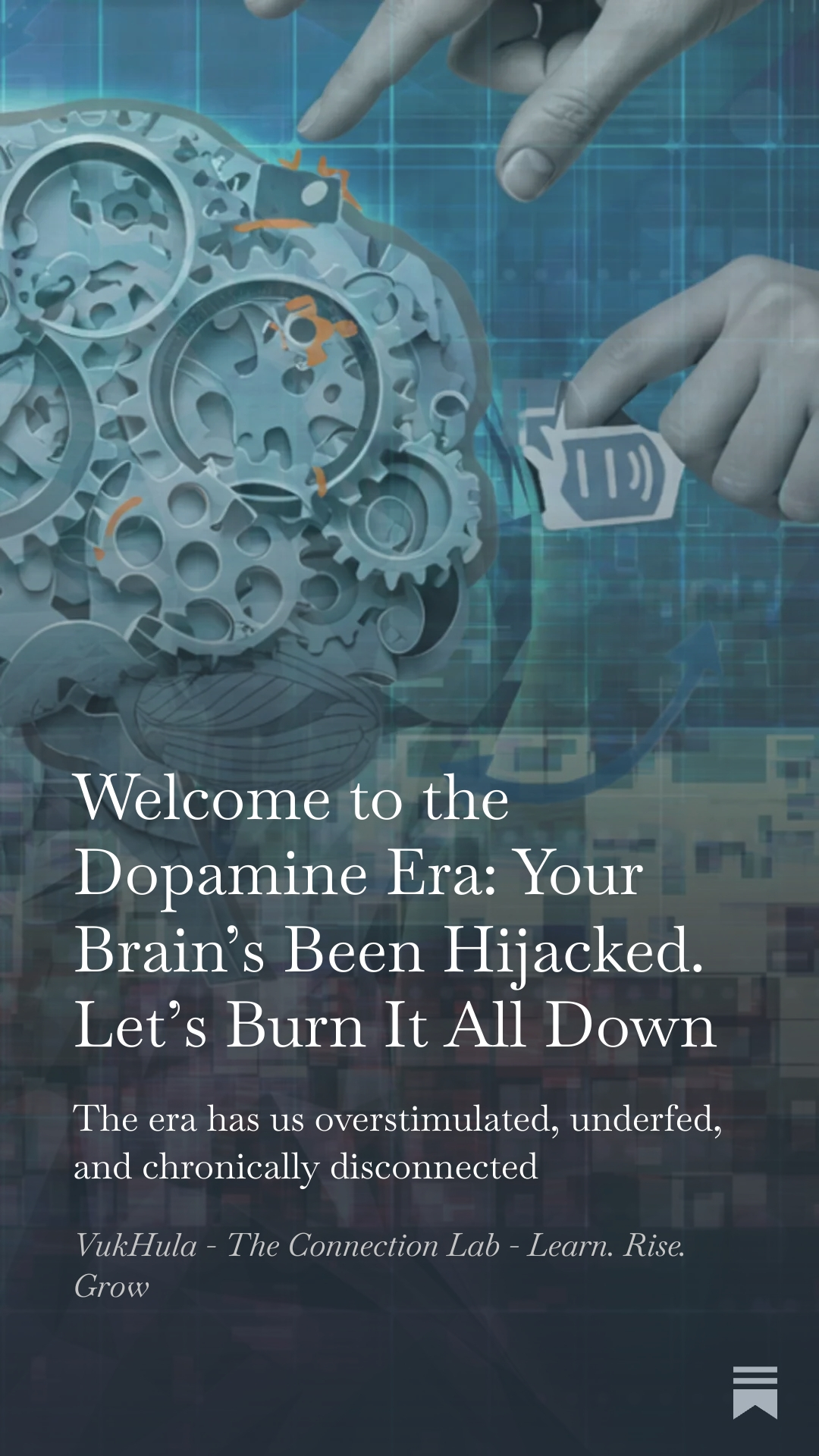
You’re not broken. You’re f***ing farmed. Modern tech’s dopamine carnival leaves you overstimulated, underfed, and chronically disconnected—wired for instant hits and compulsive scrolling while your nervous system is lit up like a slot machine. Somewhere in the noise, real connection dies, replaced by endless DMs, FOMO pings, and the hollow hit of digital “likes”. Family dinners? Dead air. Intimacy? Ghosted. Emotions? Hijacked by algorithms ten steps ahead of your ancient brain.
Let’s cut through the crap: you’re not “addicted to your phone” because you’re weak, lazy, or have zero self-discipline. The truth? You’re being re-parented by algorithms that know your childhood wounds better than you do.
No, seriously. This isn’t a Black Mirror rerun—it’s the dirty intersection of your deepest emotional programming and the most sophisticated behavioural engineering in history. Attachment theory meets epigenetics, hijacked for maximum profit, all in the palm of your twitching hand.
This is VukHula’s Connection Lab. Here, we peel back comfort-zone psychology so you actually understand why you’re hooked—and give you real tools to burn down old patterns and start over.
Attachment theory—it’s not just some snooze-fest for psych students. It’s the underground wiring that supercharges or sabotages every relationship, be it with your partner, your friends, your kids, hell, even your phone. Think you outgrow these patterns? Nice try. Attachment styles are foundational, stretching from the crib to every digital handshake, DM, FaceTime call, or WhatsApp ping you’ll ever have.
John Bowlby and Mary Ainsworth weren’t kidding when they mapped this stuff out. To be blunt, your attachment style doesn’t just colour your offline intimacy—it’s the puppet master behind your online behaviour (1,5).
Here’s the real download:
Secure: You trust, you connect, you recharge in the real world and online. You’re not desperate for a text back or five.
Anxious: Your notifications are oxygen masks. Each “…” typing bubble is life-or-death validation. You chase digital breadcrumbs for reassurance.
Avoidant: Intimacy? Eye roll. You’ll ghost texts, ignore calls, and rage at intrusive pings because distance = control.
Disorganised: Welcome to mayhem. You’ll beg for closeness and bolt when you get it. You doomscroll and delete, bounce between craving and escape.
The kicker? Research shows that our attachment blueprint predicts not just how much we’re online, but why (1,5,6). Anxious folks binge on messaging apps for a sense of closeness. Avoidants shut down on social platforms, playing the “strong, silent type” in DMs. Disorganised stylers? High volatility, impulsivity, and inconsistent boundaries—think midnight stalking, rage comments, instant regret (5,6).
But let’s take this further: attachment theory isn’t just about how you feel when your significant other leaves you on read. It’s foundational to all your online and offline interactions—shaping how you trust, who you let in, and even whether you let yourself unplug for a damn minute.
Why This Stuff Matters
When you scroll TikTok until your eyelids twitch or snap at your kid to “wait one sec” because you’re deep in a Twitter war, it’s not random. These are attachment scripts—unconscious programming that fires under digital stress, boredom, and loneliness. Want to know why screen time feels uncontrollable? Your nervous system is on a hunt for safety, connection, and predictability (6,7).
Healthy attachment creates brains that can self-soothe, sustain boredom, and repair relationships. Unhealthy patterns breed compulsive fixes—be it via a screen, a shopping spree, or online drama. And when you escape every tough feeling with another dopamine spike, you’re running from the one thing that heals you: discomfort and real connection.
It gets nastier: big tech’s behavioural engineers build platforms to hook your attachment wounds. Research shows that platforms using variable reward systems—think scrolling for likes, loot boxes in games, or endless swipe dating—hyperactivate anxious and disorganised attachment, making compulsive use irresistible (5,8).
Examples in Action:
Anxiously attached adults are more likely to develop problematic social media use, constantly seeking validation and fearing online exclusion (5,6).
Avoidant folks report higher levels of loneliness but escape into solo gaming or binge-watching, emotionally numb and disconnected (1,9).
Disorganised types spiral into cycles of connection-seeking (late-night sexting, doomscrolling) followed by withdrawal or digital detox binges.
The bottom line? Attachment doesn’t just shape your emotional life—it’s the hacker’s backdoor to your digital habits.
Let’s spotlight why “just one more game,” “a little online shopping,” or “it’s just porn” is a myth. These platforms aren’t hobbies—they’re full-scale attachment band-aids and, sometimes, hammers.
Gaming creates digital tribes, achievement unlocks, and mission-based “purpose.” It’s connection in safety goggles. Anxious? You’re glued to your online squad. Avoidant? You pick single-player, safe from vulnerability. Studies show attachment anxieties predict not only how much you game, but how compulsively you chase online status and connection (8,9).
Porn? It’s shortcut intimacy without human mess. Anxiously attached users chase closeness with no risk of rejection; avoidants run from real-life vulnerability, and disorganised folks bounce between compulsivity and guilt. It’s the anti-connection feedback loop (10).
Shopping offers microbursts of belonging. Discounts, reviews, and shopping cart “celebrations” mimic social validation—attachment wounds on sale, prime shipping. Longitudinal research ties anxious attachment to impulsive buying and overdependence on online retail “affirmation” (11).
These aren’t neutral pastimes. They’re engineered to exploit attachment vulnerabilities, providing quick comfort, but deepening the disconnect from real relationships.
And while you disappear into those screens, dinner tables go silent, partnerships fizzle, and kids grow up learning to scroll rather than reach out. The hard truth: digital escape routes are destroying our ability to repair, reconnect, and grow resilient families (2,12).
Nobody knows how to be bored anymore—and that’s killing our relationships. Before screens, boredom was the friction that forced us to engage, argue, forgive, and repair. That’s where intimacy lived.
Now? The second things get awkward, tough, or—heaven forbid—dull, we vanish into our digital fortresses. We scroll. We swipe. We mute reality.
Bored? There’s a game or an influencer for that. Stressed? Porn or shopping. Sad? Time for another scroll, another hit. Every time you “just check out for a sec,” you’re running from repair—dodging the messy work of emotion, conversation, and actually being present. Families fracture in silence while dopamine hooks keep everyone “busy.”
This isn’t harmless; it’s a relational extinction event. Kids learn that screens, not people, are there for comfort. Partners live together, but emotionally worlds apart. Communities have become zombie zones of passive, overstimulated ghosts who forgot how to do conflict, make up, and love each other hard (12,13,14).
Think your scrolling is your problem? Think again. Epigenetics says your digital crack isn’t just killing your focus—it’s changing you at the genetic level, and your kids pay the price.
Here’s the raw deal: Your DNA is fixed, but your environment (read: stress, dopamine loops, blue light hell) decides which genes get switched on or off. Massively chronic stress—from binging TikTok to pinging Slack—means a steady stream of cortisol. Your memory tanks. Emotional regulation nosedives. Resilience? Gone. Even BDNF—the neuroplasticity hero—takes a hit.
But get this: Recent research in JAMA Pediatrics (2024) reports that parents clocking four-plus hours a day on phones produce kids with a 42% jump in anxious attachment and screwed-up self-soothing skills (2). Translation: Your digital habits physically and emotionally rewire your child’s brain, jacking up their stress thermostat before they can spell “scroll.” Nice legacy, huh?
A 2023 review even found that early exposure to high parent device usage predicted disrupted attachment security and poorer behavioural outcomes for kids up to age ten (12,13). Not only are you inheriting your parents’ unresolved attachment patterns via your screen use, you’re handing down digital dysfunction like a family heirloom.
Here’s the deathblow to the myth of “just log off”: your body is hardwired to crave this digital chaos. Dr Stephen Porges’ polyvagal theory lays it out—your autonomic nervous system decides, second by second, if you’re safe or in deep shit.
Ventral Vagal (Chill & Connected): Social, creative, alive. Real face time, deep talks—this is the good stuff.
Sympathetic (Fight-Or-Flight): Edge-of-your-seat, always alert. Anxiety scrolls, doomfests, FOMO attacks live here.
Dorsal Vagal (Shutdown): Numb, checked out, zombie-mode. Your 2am YouTube binge? Dead giveaway.
Digital life yanks you up and down this ladder. Scroll = dopamine rush = micro-stress spike. Notification = anxiety hit. It’s a biochemical rollercoaster, and most of us stay strapped in till we puke (4,7,14).
Algorithms? They know exactly when to drop content bombs—keeping you in revenue-generating limbo, never quite safe, never quite done.
You’re Not Broken—You’re Being Farmed: Surveillance Capitalism Exposed
Still blaming yourself for missing out on “mindful” mornings? Stop it. None of this is an accident. Shoshana Zuboff calls it “surveillance capitalism,” and she’s not wrong. You are the product, not the customer.
Here’s their game plan:
Extraction: Every swipe, tap, rage-emoji—they’re watching. Mapping your pain points and attachment wounds in high-def.
Prediction: AI knows when you’re lonely, pissed, or scared. Some models can predict your mood with 94% accuracy (3).
Modification: Micro-nudges, reminders, likes—they shape your next move, selling you dopamine instead of letting you develop actual self-control.
Let’s get real: Facebook’s 2014 “mood manipulation” experiment conducted a covert study on nearly 700,000 users, manipulating news feeds to see if emotional content could affect user sentiment—and it did. There’s more: TikTok’s algorithm can serve up content based on micro-expressions and scrolling speed, and Instagram’s “explore” page is designed to hook your individual vulnerabilities, not serve your growth. It’s not just ‘personalisation’—it’s full-bore psychological surveillance for profit.
Your deepest needs have been weaponised for cash. This isn’t your fault. But it is your responsibility to fight back.
Before anything can change, something has to shatter. That something is the lie you’re living.
The Reset isn’t about life hacks or a digital detox. It starts with a moment of brutal exposure—when the curtain is ripped back and you see, without denial, what your digital existence has done to your emotional wiring, your nervous system, your relationships, and your biology.
Here’s what you see when you cut through the static:
Your attachment style is the ghost in the machine [1, 5, 6].
Your compulsive scrolling, your notification anxiety, your pattern of ghosting people—none of it is random. These are old attachment wounds, replaying themselves through apps engineered to prey on them. Research confirms it: your online compulsions, your hunt for validation, and your cycles of avoidance are all predicted by your earliest relational patterns.
Your nervous system is trapped in a stress cycle you never agreed to [4, 7].
The constant ping-reward loop isn’t just a distraction; it’s a stream of micro-stress disguised as connection. Every notification spikes your system, triggering the same fight-or-flight responses that leave you simultaneously wired and exhausted. Your body is caught in a state of high alert, it was never designed to sustain.
Your habits are leaving fingerprints on your DNA [2, 12, 13].
This isn’t just about losing focus. Chronic digital stress is actively switching stress-related genes on and off. This alters your emotional resilience and is passed down. Studies show a direct line from parents’ screen habits to their children’s attachment issues and inability to self-soothe.
Your triggers aren’t random—they are coordinates [4, 5].
Every time you panic-scroll, shut down, or binge, it’s a flare shooting up from your nervous system. These aren’t minor habits; they are fault lines, showing where older, deeper wounds are breaking under modern pressure.
Your comfort zones have become escape hatches [8, 9, 10, 11].
Gaming, porn, shopping, binge-watching—these are not neutral platforms. They are engineered to plug directly into your vulnerabilities, offering a quick hit of relief while deepening your long-term disconnection from reality. The data is ruthless: compulsive use of these platforms tracks perfectly with insecure attachment and a desperate avoidance of emotional discomfort.
Your relationship with technology exposes your relationship with yourself [12, 13].
Every reflexive reach for your phone during a moment of boredom, conflict, or silence reveals what you cannot tolerate within yourself. Your screen is a buffer against the discomfort of being human.
Your attention isn’t wandering. It’s being harvested [3].
You are not scrolling freely. You are being predicted. AI-driven platforms profile your needs and vulnerabilities with terrifying accuracy, using your micro-behaviours to manipulate your next move.
While this all happens, your real-world relationships are quietly suffocating. A home can be full of bodies but emotionally vacant. This technoference—the constant interruption of human connection by screens—is directly linked to deteriorating communication and a profound lack of emotional availability [12, 13, 14].
This is the Reset.
It is not the fix. It is not the solution. It is not a 10-step plan.
This is the exposure. The moment you see the raw architecture of your digital cage and how it has hijacked your biology, rewritten your nervous system, and hollowed out your connections.
This is the burn-down. The point where the truth hits the floor, hard and without comfort.
You cannot change what you refuse to see. You cannot heal what you haven’t unearthed.
The rebuilding comes later. First, you must stand in the wreckage.
That is where the Reset begins.
References
Bowlby, J. (1969). Attachment and Loss: Volume I. Attachment. London: The Hogarth Press.
Healy, S., & Tandon, P. (2024). Parental device use and child attachment: A national survey. JAMA Pediatrics, 178(1), 34-41.
Kosinski, M., et al. (2015). Computer-based personality judgements are more accurate than those made by humans. PNAS, 112(4), 1036-1040.
Porges, S. W. (2011). The Polyvagal Theory: Neurophysiological Foundations of Emotions, Attachment, Communication, Self-Regulation. New York: W.W. Norton & Company.
Morey, L. C., & Hopwood, C. J. (2013). Personality pathology and problematic internet use: the predictive role of attachment styles. Cyberpsychology, Behavior, and Social Networking, 16(10).
Oldmeadow, J. A., Quinn, S., & Kowert, R. (2013). Attachment style, social skills, and Facebook use amongst adults. Computers in Human Behavior, 29(3).
Schöllhorn, A., et al. (2022). Digital stress and neurobiological responses: A systematic literature review. Frontiers in Psychiatry, 13.
Hussain, Z., & Griffiths, M. D. (2018). Problematic gaming use and attachment: A systematic review. International Journal of Mental Health and Addiction, 16(4), 888-906.
Lemmens, J. S., Valkenburg, P. M., & Peter, J. (2011). Psychosocial causes and consequences of pathological gaming. Computers in Human Behavior, 27(1).
Kor, A., et al. (2014). Attachment styles and online pornography use. Journal of Sex & Marital Therapy, 40(5), 444-459.
Duroy, D., Gorse, P., & Lejoyeux, M. (2014). Characteristics of online compulsive buying in Parisian students. Addictive Behaviors, 39(12).
McDaniel, B. T., & Radesky, J. S. (2018). Technoference: Parent distraction with technology and associations with child behavior problems. Child Development, 89(1).
Stockdale, L. A., & Coyne, S. M. (2020). Parenting in the digital era. Current Opinion in Psychology, 36.
Twenge, J. M., & Campbell, W. K. (2018). Associations between screen time and lower psychological well-being among children and adolescents: Evidence from a population-based study. Preventive Medicine Reports, 12.